Return to a Caption Project Without Unnecessary Memory Tests
Give returning editors a sign-in path they can complete with assistance: support password managers and pasting, and make an alternative available when a step otherwise demands recall or transcription. Keep the sign-in check separate from checking whether the correct caption revision reopened. A successful login alone does not establish that the project is intact.
When choosing the best ai music generator for an ongoing lyric project, consider the return journey as well as the first export. This guide supplies a review method, not vendor authentication results. No credentials, identity checks or sign-in challenges were automated for this article.
Start with a small handoff record
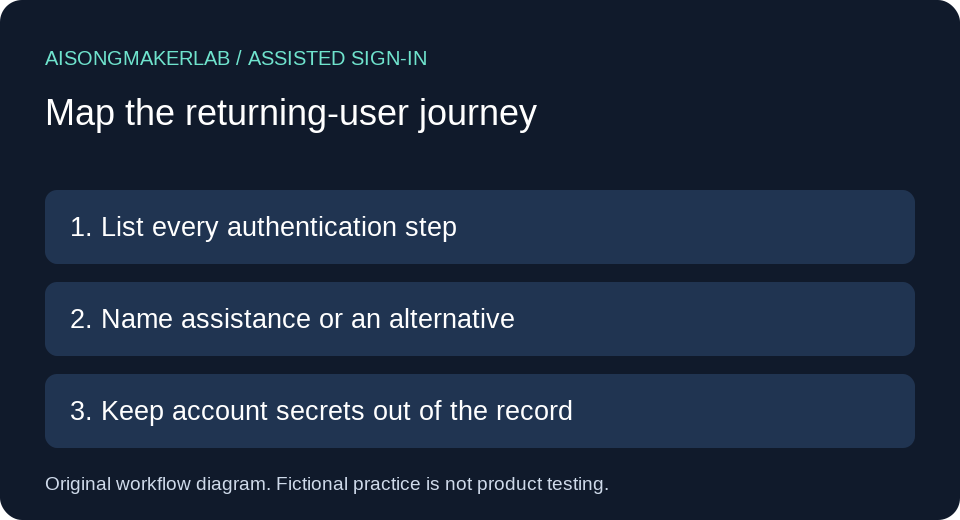
Record the project reference, the authentication step, the assistance offered and the remaining check. Do not put a password, recovery code or live sign-in link in the worksheet. Its purpose is to describe interaction behavior, not to hold account access material.
W3C's explanation of accessible authentication, minimum addresses returning-user authentication. It describes alternatives or assistance for cognitive tests, alongside object-recognition and personal-content exceptions. Password-manager support and copy-and-paste are examples of assistance. This is one accessibility consideration, not a complete accessibility or security certification. Recognition exceptions do not mean every puzzle is equally usable.
A practical comparison sequence
- List each step a returning editor would encounter, including any second step after the password.
- Describe the assistance available at each step, without collecting secrets.
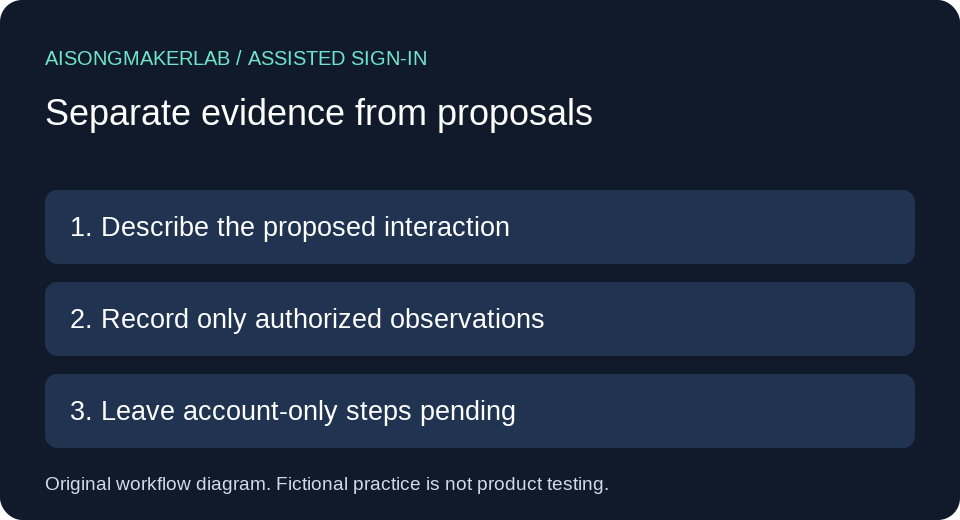
- Distinguish a proposed behavior from an observation made by an authorized reviewer.
- Record the browser and input method for any actual review; do not generalize one result to every device.
- After the account holder returns, separately confirm the project reference and approved caption revision.
The design target is an assisted return path. It is not removal of identity verification. If a review reaches a real account challenge, leave that step to the account holder and record it as pending.
Five self-authored fictional cases
The following five cases are explicitly fictional, authored for this guide. The names, projects and interface behaviors are invented design exercises, not generated vendor results, customer quotations or performed tests. Each proposed acceptance check still requires an authorized review before it can be marked observed.
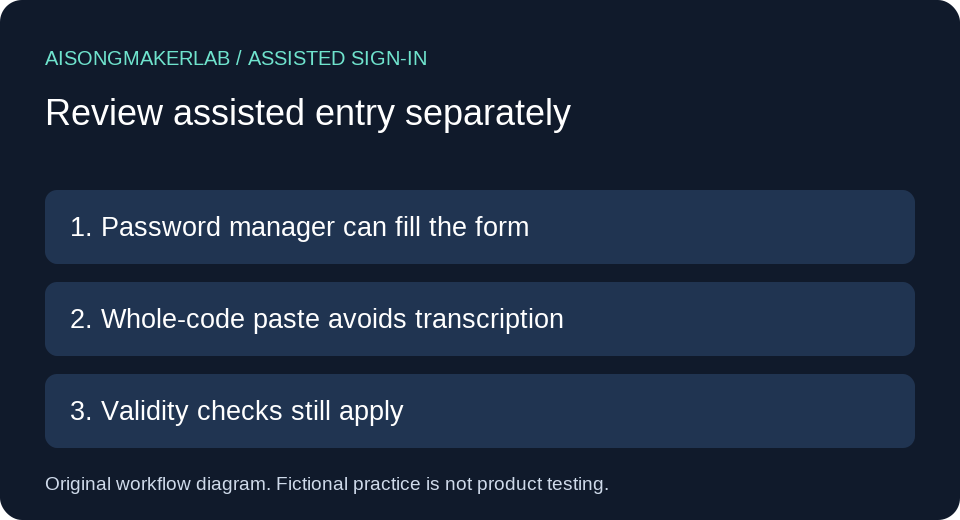
1. A password manager fills the returning editor's form
Fictional editor Mara returns to a project named Evening Chorus. In the proposed design, the username and password fields expose appropriate input purposes so her password manager can identify them. The team initially considers a custom canvas keypad because it matches the music player's appearance. Mara's scenario reveals a more useful requirement: the sign-in controls need to cooperate with the entry assistance she already uses.
The worksheet entry reads: step, existing-account password; assistance, password manager; proposed outcome, both fields can be filled without memorizing the password. It contains no password and no screenshot of credentials. The designer also records a pending check for the submit control after the fields are filled. A form that accepts assisted entry but then silently clears it would not complete this proposed interaction.
After sign-in, Mara would compare the project reference with her handoff note. That second check addresses mistaken project selection, not password-manager compatibility. Until the account holder performs the return journey, both observations remain pending. The design decision is to use recognizable form controls and preserve assisted entry, rather than treat a styled mockup as evidence of successful authentication.
2. A one-time code can be pasted as a whole
Fictional editor Eli receives a code through a channel he controls. A draft interface divides the code into several boxes and assumes users will remember each character while switching windows. Eli's proposed review asks whether the complete copied value can be pasted into the code entry area, including when the visual design keeps multiple boxes.
The record names the step as a second authentication factor and the assistance as whole-code paste. It describes expected behavior without saving the real code. If the interface distributes a pasted value across boxes, the team must verify that distribution rather than assume the decorative layout implements it. An expired code is a separate state: accepting paste does not require accepting an expired value.
The proposed correction is to explain expiration and let the account holder request a replacement through the normal flow. Eli should not need to retype a code merely to satisfy an arbitrary input restriction. The worksheet leaves paste behavior and expiration messaging as separate pending checks. This separation prevents a failed or expired credential from being misreported as a paste failure, while still identifying an entry barrier when the input itself rejects assistance.
3. An alternative avoids a required memory challenge
Fictional editor Nia encounters a proposed question asking her to recall an old project nickname. The design team argues that the nickname is familiar because she created it. Nia's case challenges that assumption: familiarity is not evidence that someone can reliably retrieve a string from memory when returning months later.
The team proposes an alternative authentication path that does not require recalling the nickname. The worksheet identifies where the alternative appears and whether it remains available after the first path is selected. It does not prescribe an unreviewed security implementation or claim that a particular provider offers such a route. The account and security teams would still need to evaluate the actual method.
For the caption workflow, the practical acceptance question is whether Nia can discover and complete the alternative without first answering the memory question. An alternative hidden behind the same challenge would not solve this fictional problem. The reviewer records the method description and the pending navigation check, not an answer to the question. Reopening the correct lyric revision remains a separate check after authorized access. The exercise produces a clear design requirement without pretending to have bypassed a real challenge.
4. Assisted entry survives ordinary interaction
Fictional editor Tomas uses a password manager and keyboard navigation. A proposed form allows a value to be filled but attaches a script that clears the field whenever focus leaves it. The visible form looks ordinary, yet the proposed behavior would force Tomas to repeat entry as he moves toward the submit button.
The team writes a short interaction sequence: fill with assistance, move focus to the next control, inspect whether the entry remains available, then allow the account holder to submit. The worksheet describes the state transitions without storing field contents. It also distinguishes a deliberate account-holder reset from an automatic clearing event. Those events should not be combined under a vague label such as login difficulty.
The proposed fix removes unnecessary clearing while retaining appropriate handling of failed or expired credentials. The case does not claim that keeping a field populated is a complete authentication policy. Its contribution is a specific assisted-entry review sequence with a known stopping point. If keyboard operation or manager behavior has not been reviewed in the actual environment, the record says pending instead of reporting compatibility from the appearance of the form.
5. An untested identity step remains untested
Fictional reviewer June can inspect a public sign-in form but has no authorized test account. She can describe the visible labels and the offered routes. She cannot truthfully report what happens after submission, whether a second factor appears, or whether a saved caption project reopens. The worksheet therefore gives each step its own evidence state.
June records public form observed for the visible entry screen and not reviewed for the account-only steps. She leaves a follow-up task for the account holder: complete the normal return journey and report whether assistance remained available. The note requests behavior observations only, never a password, live code or identity document. A marketing page's sign-in link is not substituted for a completed account journey.
Her final fictional handoff separates the accessible-entry proposal, the unavailable authentication evidence and the project-revision check. That is more actionable than marking the entire vendor accessible or inaccessible from one screen. It also keeps the publication honest: the guide can offer useful review materials today while leaving real account behavior explicitly unknown. No invented success rate or test duration fills the gap.
Keep the comparison reviewable
Use the blank CSV to record a step, assistance method, proposed behavior, actual observation, environment and pending reviewer action. Keep credential values out of every column. The fictional cases are downloadable separately so they cannot be mistaken for completed account tests. If an observation changes, preserve the earlier note and date the new one.
Frequently asked questions
Does this mean passwords must disappear?
No. Assistance such as password managers can reduce the need to remember or manually enter credentials. Evaluate the whole return path rather than only the first field.
Is a pasted code automatically valid?
No. Entry assistance and credential validation are separate. A code can be pasted successfully yet be expired or incorrect.
Can a sign-in link prove that a project will reopen?
No. Returning to the correct project and revision needs its own observation after authorized access.
Are these cases product test results?
No. All five are self-authored fictional design exercises. Actual vendor authentication behavior remains untested here.
What should a reviewer record when access is unavailable?
Name the unreviewed step and the behavior still needing confirmation. Do not guess a pass or fail and do not request account secrets for the worksheet.
Sources and limits
The W3C source above supplies the authentication principle. The review sequence, worksheet, diagrams and fictional caption scenarios are our authored application of it. On November 25, 2026, the public OpenMusic music-video page used a format selector, showcase, explanatory sections and FAQs. That page structure informed our decision to pair a short answer with task examples and questions; it supplies no authentication test evidence. No claim is made about every competitor page or Google rankings.
Download the five fictional cases · Download a blank review CSV