Warn Caption Editors Before Inactivity Can Lose Their Work
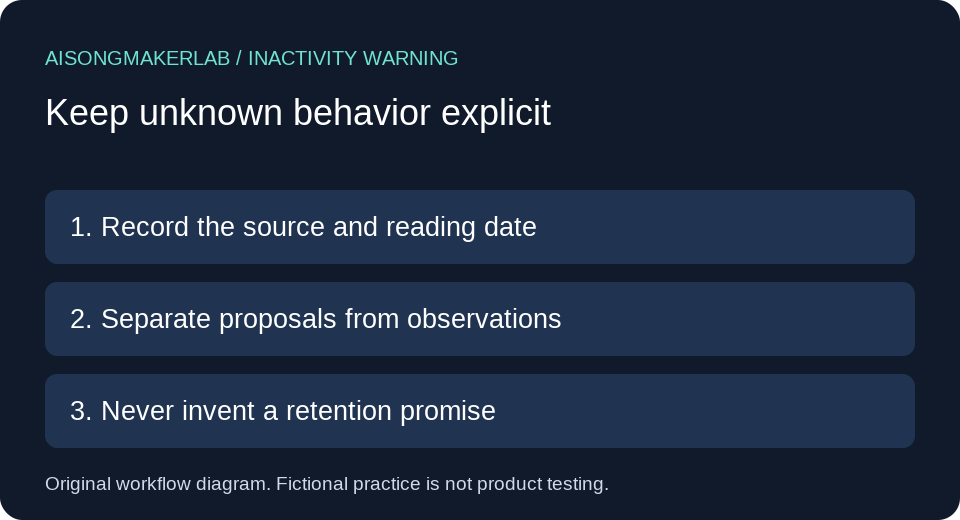
Give editors an advance, specific explanation of any inactivity period that can discard their caption work. Say which unsaved changes are at risk, distinguish signing out from losing data, and offer a concrete save or export action where one exists. If the duration or retention behavior is unknown, record that uncertainty rather than inventing a reassuring promise.
Choosing the best ai music generator also means planning the work around its output. A lyric caption pass may involve listening, consulting an approved lyric sheet, and taking breaks between revisions. This guide supplies a warning worksheet for that downstream task. It does not assert that any named generator implements a particular timeout.
Start with a small handoff record
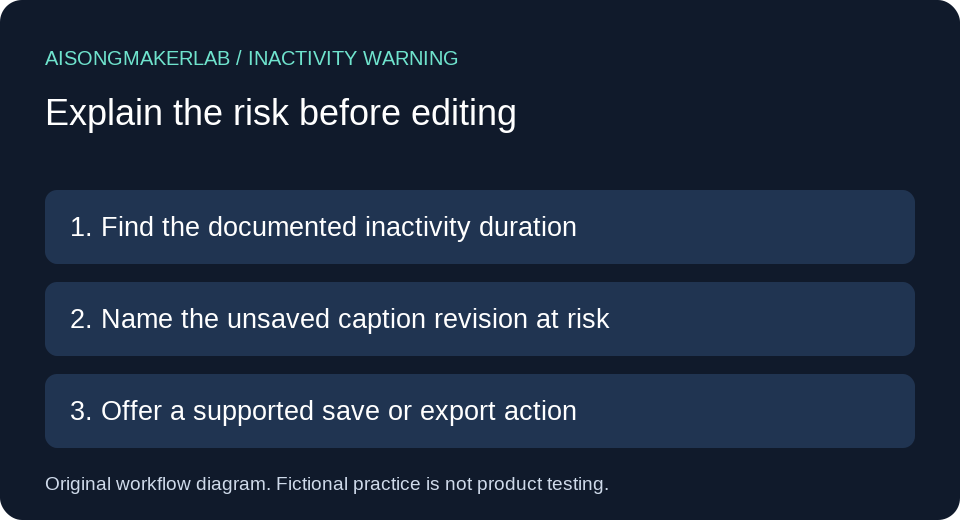
Write down the project reference, the caption revision being edited, the affected storage location, and the source of the timeout information. Keep a proposed notice separate from a notice actually read in the product. A blank duration is a research task, not permission to fill in a common default.
The W3C explanation of SC 2.2.6 Timeouts describes a Level AAA criterion: warn users about inactivity duration that can cause data loss, unless their data is preserved for more than 20 hours without action. Its guidance places notice at the beginning of the process. It concerns timeouts within the provider's knowledge or control. This article applies that idea to caption editing; it is not a conformance certification.
A practical comparison sequence
- Identify the exact editing surface: local caption file, browser draft, or saved server project.
- Find documented inactivity duration and affected data. Save the source URL and reading date.
- Draft a notice that names the duration, consequence, and available action. Mark invented examples as fictional.
- Place the notice before substantial caption entry, beside the task context rather than buried in unrelated help.
- Record any authorized observation separately. Never infer successful preservation from a save icon alone.
An advance explanation and an expiring-session interaction serve different purposes. W3C SC 2.2.1 Timing Adjustable separately addresses turning off, adjusting, or extending content time limits, with defined exceptions. An attractive warning sentence alone does not settle that review.
Five self-authored fictional cases
All five cases below are self-authored fictional design exercises. Names, project details, and example durations are invented for explanation. They are not generated vendor results, user quotations, measured retention periods, or reports of product testing.
1. Explain the limit before the first timing edit
In this fictional case, Mira is preparing captions for a song called Paper Lantern. She plans to compare the chorus with a separate lyric document before entering cue times. The invented editor specification says unsaved browser edits are discarded after thirty minutes without a recognized user action. That number belongs only to this exercise.
The proposed notice reads: Unsaved caption changes are discarded after thirty minutes of inactivity. Save your draft before taking a break. Place it above the first editable cue, where Mira can use it to plan the work. Do not hide it under an export tab she has no reason to open yet. The worksheet records the notice as proposed copy, with no actual observation entered.
The design question is whether Mira learns the consequence before investing effort. A reviewer would separately establish which actions the real editor counts as activity; passive listening cannot simply be assumed to reset a timer. If the specification does not define that behavior, retain the uncertainty. The next action is to obtain the documented rule, not to replace thirty minutes with another guessed number.
2. Separate sign-out from loss of unsaved changes
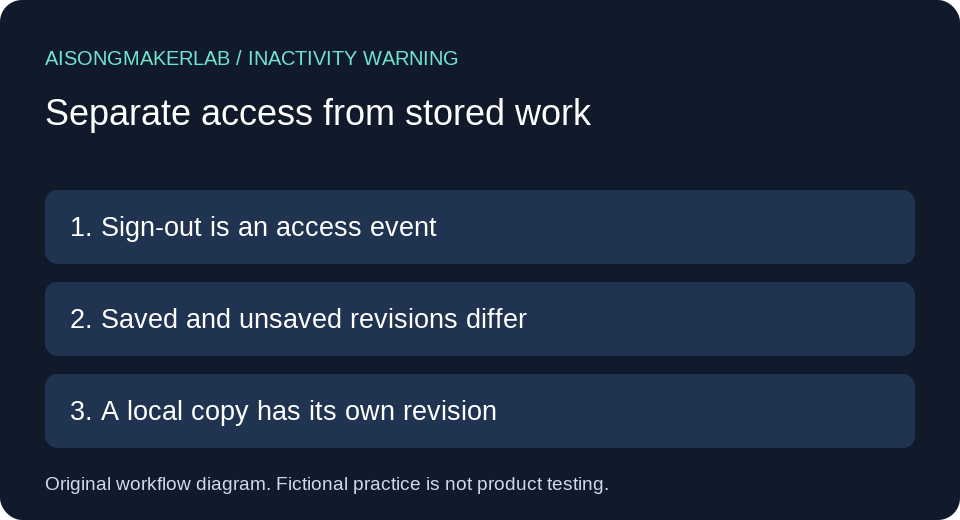
In this fictional case, Jonah sees an account message that says the session ends after a period of inactivity. His caption project contains a saved verse and a newer chorus revision still in the editing form. The proposed review record splits those objects into two rows. One row describes access to the account; the other describes persistence of the unsaved chorus.
A sentence saying that the user will be signed out does not explain whether the chorus survives. Conversely, a project appearing in a library does not establish that the latest unsaved words are stored. The proposed copy must identify the affected revision and the action available to preserve it. Until the fictional product specification resolves those points, the data-loss consequence stays marked unknown.
For a future authorized review, Jonah would use a disposable draft and record its revision before leaving it idle. This article does not report that exercise as performed. The practical contribution is the two-row distinction: account access and caption persistence can fail independently. The reviewer should not convert an authentication observation into a retention result, or promise that signing in again will recover every edit.
3. Keep server storage and a local draft separate
In this fictional case, Leila has downloaded an earlier subtitle file but is making additional cue corrections in a browser. A teammate proposes the reassuring notice Your work is backed up. The worksheet rejects that sentence because it does not name the revision, storage location, or success evidence. The downloaded file and the current browser edits are different objects.
The replacement proposal names the available action: export the current caption revision before leaving the editor, if that operation is supported. It also asks the editor to distinguish a completed export from a request that is still running. An old file on disk is useful recovery material, but it cannot establish that a later correction was preserved.
Leila's fictional handoff record includes the intended filename, a revision label, and an empty observation field for whether that file contains the changed cue. No successful download or comparison is claimed here. The decision rule is to keep storage claims narrow enough to verify. A local copy may reduce the consequence of losing a browser draft, but its existence does not reveal the server's inactivity duration or justify a blanket retention promise.
4. Make an unknown policy visible
In this fictional case, Arun reviews a caption editor whose public help does not state a retention period. A colleague suggests inserting a familiar fifteen-minute warning because it sounds cautious. Arun instead leaves the duration field unknown and records which public help page was read. The fictional omission is an exercise, not a finding about a named service.
The working note says: Inactivity duration and unsaved-draft retention are not established. Preserve a separate copy before a break where the workflow allows it. That advice describes a precaution; it is not presented as satisfying a duration-warning requirement. The proposed product notice remains pending until the product's actual behavior is known.
This distinction matters when a comparison worksheet travels between teammates. A guessed duration can quickly become a purported specification if its fictional origin disappears. Arun therefore separates source statements, proposed copy, and observations into different fields. The next step is a documented answer from the responsible product team or an authorized review with disposable material. Lack of evidence is neither proof of immediate loss nor proof that the draft is safe indefinitely.
5. Put the warning where the caption task begins
In this fictional case, Bea enters an editor through a direct project link instead of the usual dashboard. A notice on the dashboard would not reach her. Her workflow map therefore identifies both entry paths and proposes the same relevant explanation at the beginning of the editing task. This is a placement exercise; no interface has been tested.
Bea also distinguishes the initial explanation from a later warning that an active time limit is close to expiring. Repeating a long notice beside every cue could distract from the lyric revision without clarifying the rule. The proposed layout uses one readable task-level explanation and keeps the save or export action easy to locate. Whether a later extension interaction is required remains a separate time-limit review.
The worksheet records entry route, notice location, and the action described. For each route, actual visibility remains unverified until inspected in the intended environment. This prevents a design mockup from being treated as live evidence. The fictional acceptance question is specific: can someone arriving at the caption task learn the documented inactivity consequence before making substantial unsaved changes?
Keep the comparison reviewable
Use the downloadable blank CSV to capture the editing surface, documented duration, affected revision, storage location, source and date, notice placement, proposed action, actual observation, and unresolved question. Leave unavailable observations empty or explicitly unknown. The accompanying case file preserves the fictional labels so examples do not become vendor evidence when shared.
The public OpenMusic music video page, read November 26, 2026, uses a format selector, showcase, explanatory sections and FAQs. That structure helps visitors explore output types. Our worksheet instead organizes a caption editing interruption around data at risk and evidence. This is a comparison of page structure, not a test of OpenMusic retention, a statement about all competitor pages, or a ranking claim.
The original contribution is the five authored scenarios and the decision records derived from them. We count case-section words against the complete article text to audit their share; that is not an internet uniqueness score. No search volume, difficulty, bid, or authentic user quotation was available for this task.
Frequently asked questions
Does a session timeout always delete captions?
No such assumption is justified. Identify saved project data and unsaved edits separately, then record what the relevant documentation or authorized observation establishes.
Can I use a standard timeout number in the notice?
Use the actual documented duration. The numbers in these fictional cases are examples and must not be copied into a real product specification.
Does keeping a downloaded file prove autosave works?
No. A download provides evidence about that file and revision. Autosave and server retention require their own evidence.
Is an advance warning the whole time-limit review?
No. Review the time-limit controls separately under the linked Timing Adjustable guidance. A sentence describing a limit does not establish how users can manage it.
What should I do when retention is unknown?
Record the uncertainty and preserve a separate revision where possible. Do not label an unknown duration as compliant, tested, zero, or unlimited.
Download the five fictional cases · Download a blank review CSV